brokeris.be
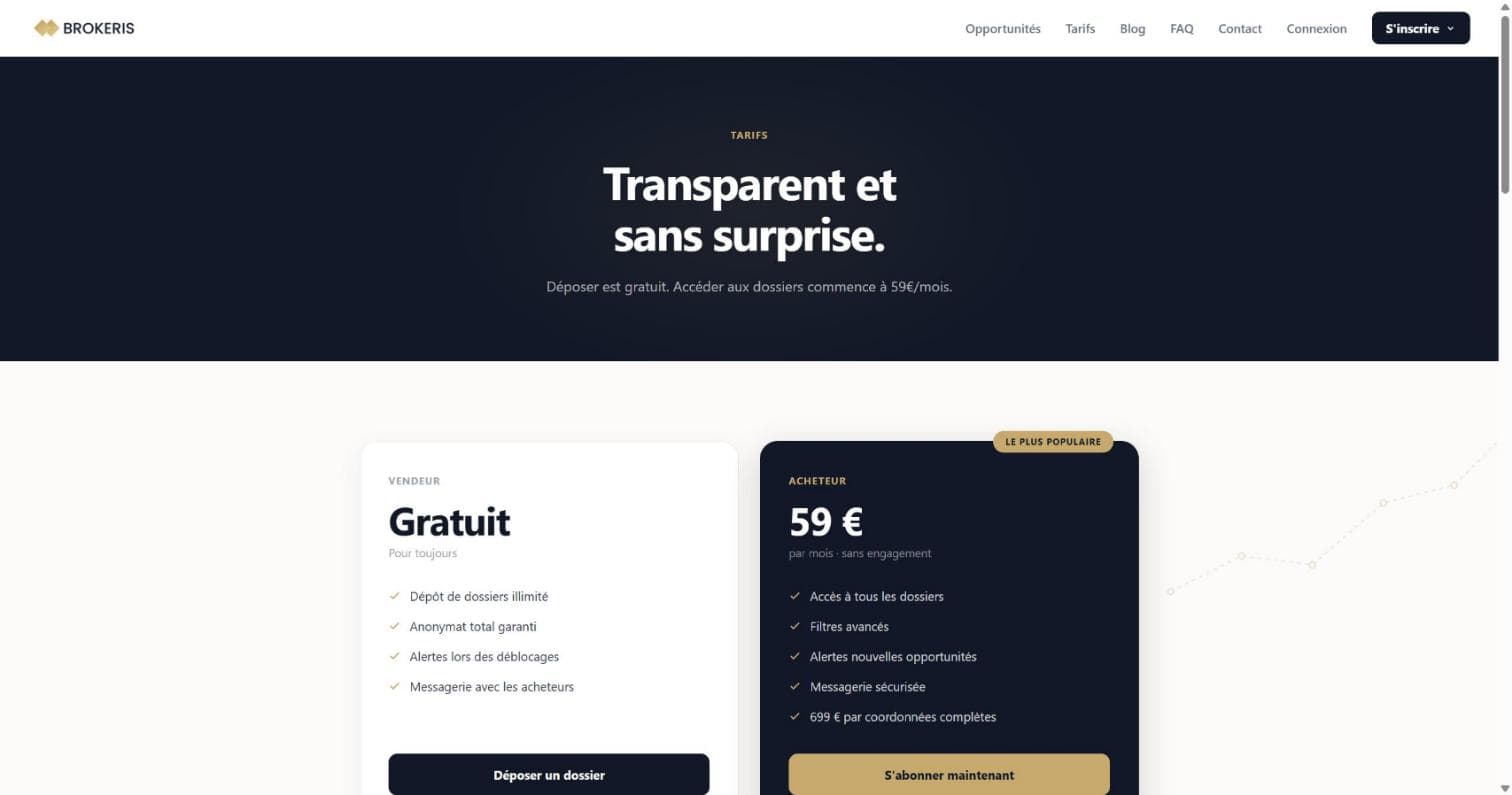
We build the tools brokers need and general-purpose software cannot deliver: confidential portfolio sales, role-based access, subscriptions.
In broking, information has both a market value and a nuisance value. A firm considering selling its portfolio cannot announce it: policyholders worry, competitors come calling, staff start looking elsewhere. The same problem affects an introducer who wants to be known without revealing their book.
This is why generic tools fail in this market. A directory publishes, a CRM stores — neither handles graduated visibility, which is precisely the requirement.
With Brokeris we built an entirely off-market portfolio sale platform. The portfolio is described by line of business and premium volume, without naming the firm. The buyer filters, identifies themselves, and only obtains the identity and documents after the seller explicitly agrees. Every document view is logged.
anonymised listing, then unlocking on agreement
before any publication, manual or automated
P&C, life, health, protection, with volumes
so the relationship stays on the platform
which may be required in a dispute over a deal
buyer access being the revenue source
What else we build for brokers
Beyond marketplaces: client portals for document submission and claims tracking, internal portfolio and commission management tools, comparison and quotation forms connected to insurer APIs, and production dashboards by introducer.
Hosting and data
Policyholder data is sensitive data. We host in the European Union by default, with a compliant processing agreement, and can host in Switzerland where a client asks. Location is decided at quotation stage, not after launch.
Budget and timeline
An introduction platform starts at €35,000 and three to five months. A client portal or internal tool starts at €20,000 and six to ten weeks. Scope is quoted feature by feature before work begins.
Platforms and sites in production, viewable online. No mockups, no invented clients.
What we concretely build within this scope.
Platforms connecting two professional populations: verified accounts, gated access, internal messaging and confidentiality by default.
Turning a service into a recurring product: trials, plans, automated payment, failed-payment recovery and a self-service customer area.
A detailed quote before we start, and a staging link from week one: you watch the project progress live, not in meetings.
Goals, site structure, content and features. You get a costed scope, line by line.
1 weekFigma mockups of every screen, desktop and mobile, signed off before any development.
2 weeksBuild, back office, content in all three languages. Staging available throughout.
3 to 6 weeksTesting, redirects, back-office training, then maintenance and monthly improvements.
ongoingThose of the work cited on this page. Code only: no WordPress, no Shopify.
Four commitments that hold over time, not four slogans.
No WordPress, no Shopify, no page builder. Your product is written in TypeScript, documented and version-controlled — the repository is yours from day one, and you are locked in to nobody.
User accounts, recurring subscriptions, messaging, gated access, payments: we have shipped five platforms running with real paying customers behind them.
Insurance broking, accountancy firms, real estate, financial recruitment. We know the data confidentiality, role-based access and domain constraints these professions carry.
FR · EN · ES. Internationalisation is built into the architecture, not bolted on as a plugin six months later — essential in Belgium, Luxembourg and Switzerland.
Yes, and that is the default configuration for this type of platform. Listings are served behind authentication, excluded from indexing and absent from the sitemap. Only the public presentation pages are indexable.
In the European Union by default, with a processing agreement specifying locations and sub-processors. Swiss hosting is available where a client's compliance requires it. It is written into the quote.
Yes, as soon as an API or exchange format exists. We regularly integrate quotation and production feeds. Where an insurer exposes nothing, we fall back on file import, with consistency checks.
The six building blocks to plan for, the ones always forgotten, and the real ranges.
This is not technical snobbery. It is a question of three-year cost.
The breakdown line by line, and why a €1,500 quote ends up costing you more.
Tell us what you need: within 48 hours you get technical feedback plus a budget and timeline estimate. No commitment.