150 €/moisAgency subscription, ex VAT
onshare.be
Mandate sharing between agencies, conversion tools for developers: we build what transaction software does not cover.
The first is cooperation. An agency holds mandates it is not selling, and buyers for properties it does not have. Sharing with a peer means settling in advance who sees what, who contacts the client and how the commission is split. Transaction software manages one agency's stock, not the relationship between agencies.
The second is conversion. A price shown as a capital sum speaks poorly to a private buyer, who thinks in monthly payments. A developer loses enquiries simply because visitors cannot picture themselves there.
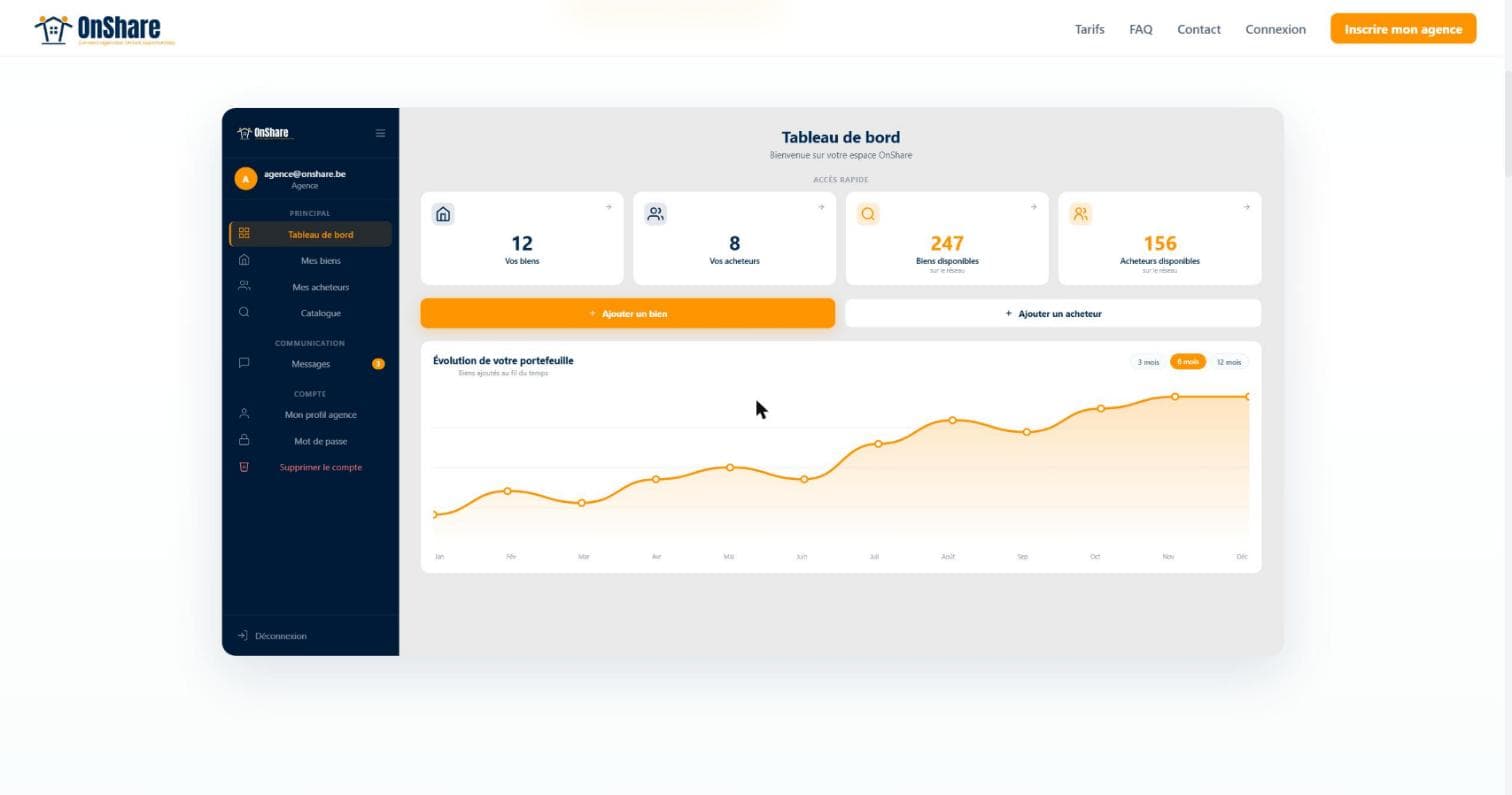
OnShare is a closed network of verified agencies sharing mandates and buyers. Visibility rules are set by the agency that owns the mandate, each agency gets its own dashboard, and network access costs €150 a month excluding VAT.
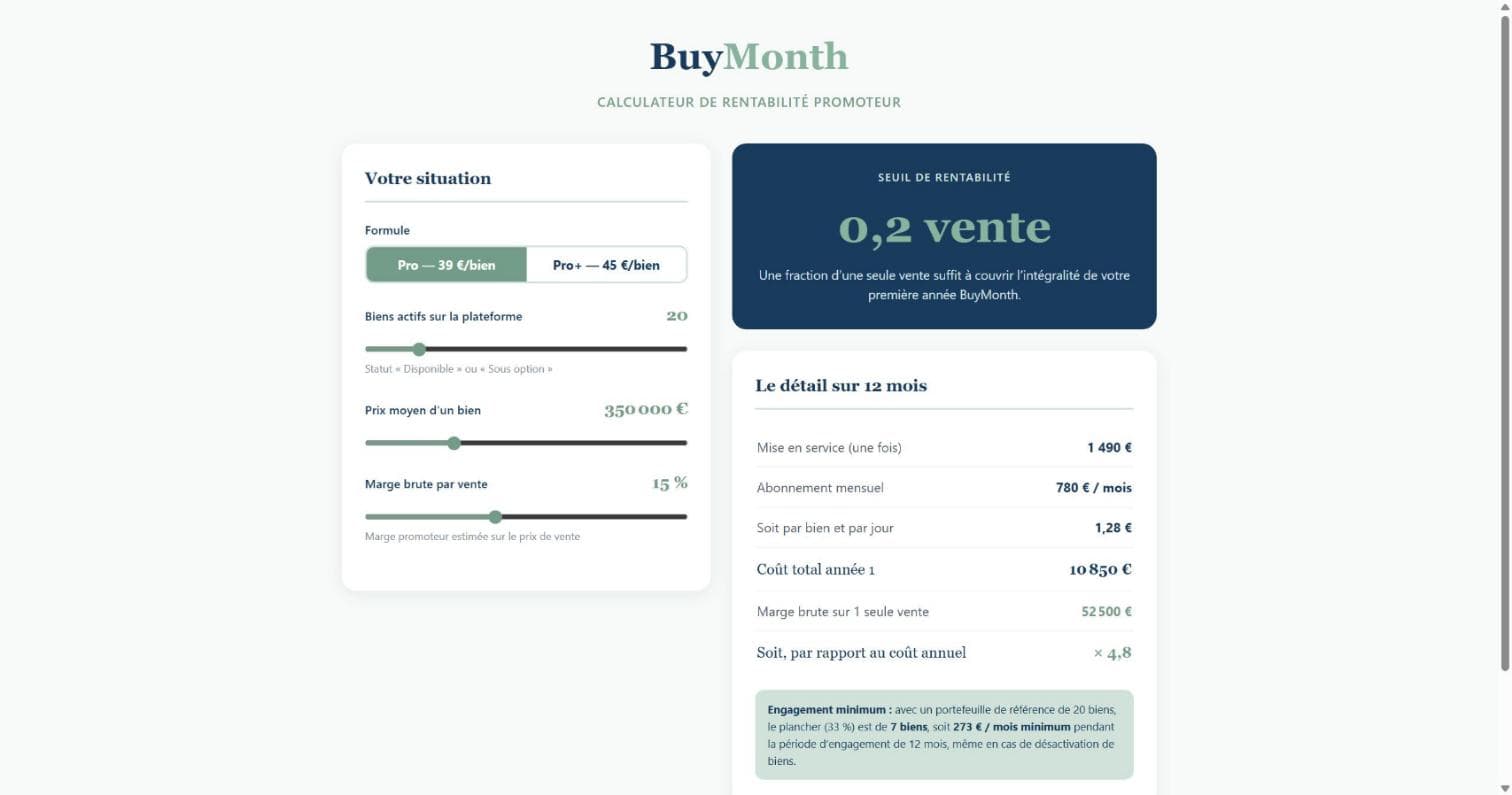
BuyMonth addresses developers: badges, widgets and QR codes that turn a sale price into an estimated monthly payment, embeddable online and on site hoardings alike, with enquiry tracking and the option to plug in lending partnerships.
with visibility rules set by the mandate owner
with structured search criteria
agreed before the introduction
on joining the network
on a third-party site, with no rebuild
compliant with the national framework
What else we build
New-build development sites with interactive floor plans and unit reservation; buyer portals for progress tracking and payment calls; agency sites with a synchronised portfolio; and bespoke rental management tools.
Budget and timeline
A network platform starts at €35,000 and three to five months. A widget-distributable conversion tool starts at €25,000. A development or agency site starts at €9,000.
Those of the work cited on this page. Code only: no WordPress, no Shopify.
What we concretely build within this scope.
Platforms connecting two professional populations: verified accounts, gated access, internal messaging and confidentiality by default.
Turning a service into a recurring product: trials, plans, automated payment, failed-payment recovery and a self-service customer area.
Internal tools, client portals and line-of-business software that replace shared spreadsheets and software nobody uses.
Four commitments that hold over time, not four slogans.
No WordPress, no Shopify, no page builder. Your product is written in TypeScript, documented and version-controlled — the repository is yours from day one, and you are locked in to nobody.
User accounts, recurring subscriptions, messaging, gated access, payments: we have shipped five platforms running with real paying customers behind them.
Insurance broking, accountancy firms, real estate, financial recruitment. We know the data confidentiality, role-based access and domain constraints these professions carry.
FR · EN · ES. Internationalisation is built into the architecture, not bolted on as a plugin six months later — essential in Belgium, Luxembourg and Switzerland.
A detailed quote before we start, and a staging link from week one: you watch the project progress live, not in meetings.
Goals, site structure, content and features. You get a costed scope, line by line.
1 weekFigma mockups of every screen, desktop and mobile, signed off before any development.
2 weeksBuild, back office, content in all three languages. Staging available throughout.
3 to 6 weeksTesting, redirects, back-office training, then maintenance and monthly improvements.
ongoingYes, where the software exposes an API or export feed, which the main vendors do. Failing that, we set up a scheduled file import, with duplicate and withdrawn-property checks.
That is precisely why the legal notices and the indicative nature of the calculation are handled at design stage, against the applicable national framework. We did this for the Belgian market on BuyMonth, and the same rigour applies elsewhere.
The six building blocks to plan for, the ones always forgotten, and the real ranges.
This is not technical snobbery. It is a question of three-year cost.
The breakdown line by line, and why a €1,500 quote ends up costing you more.
Tell us what you need: within 48 hours you get technical feedback plus a budget and timeline estimate. No commitment.